Tellis J. Chapman, Scholar and Scribe
One of the loudest questions I've often asked when reading books on preaching is, "What kind of preacher is this author?" There have been volumes of helpful books on homiletics written by individuals who were not regarded as preaching prodigies. Their contributions as preaching scholars have made an impact in the pulpit for decades.
As a student of preaching, the only thing more valuable than witnessing the sermons of a prodigy like Dr. Tellis J Chapman is having the blueprints laid on your desk. That is the difference between developing a legacy as a great preacher and entering into the realm of what Frank A. Thomas calls the scribe and scholar in his work _They Like To Never Quit Praisin' God_.
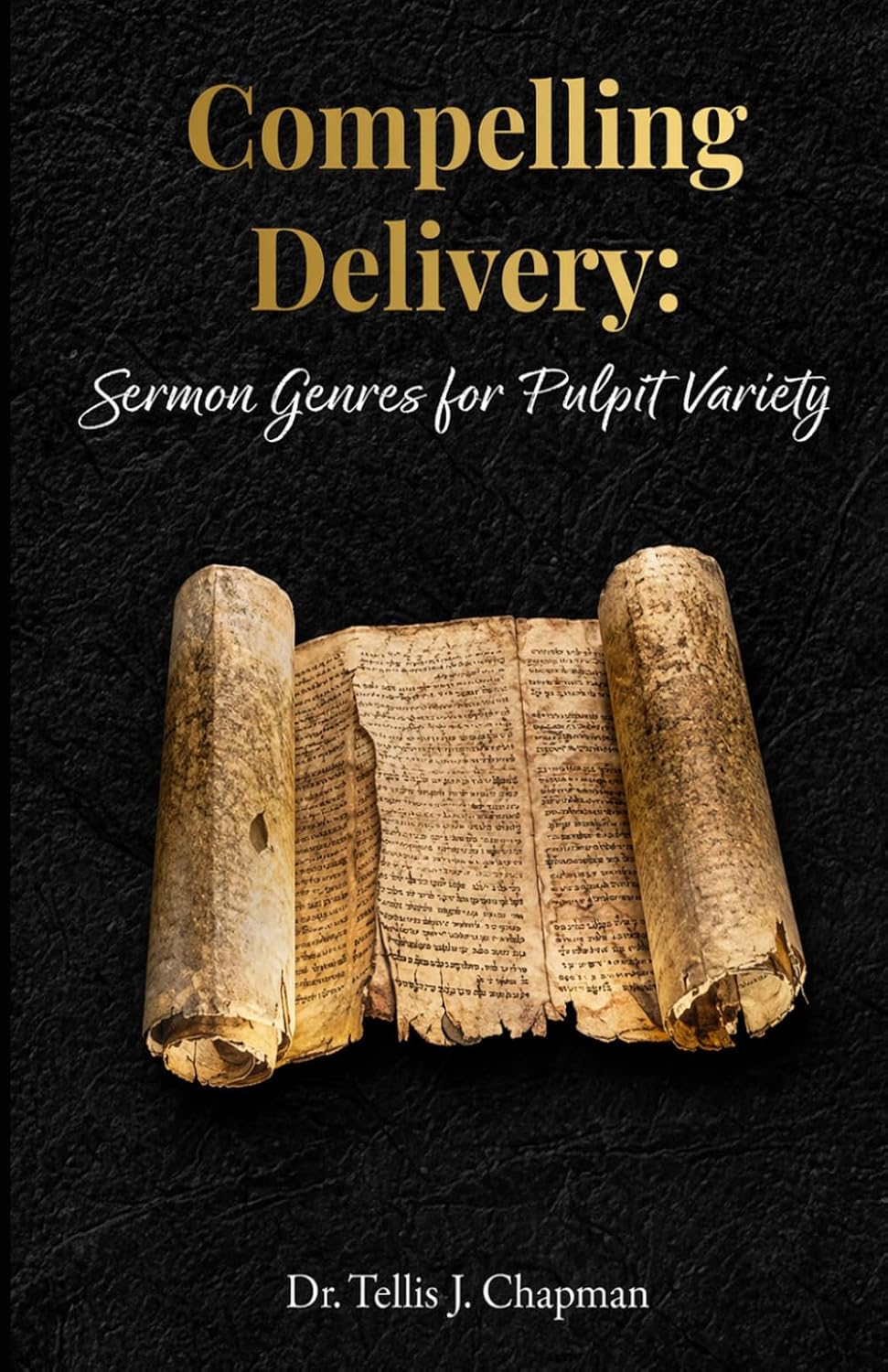
The scribes and scholars, says Thomas, "articulate homiletical theory that helps explain genius, which gives hope to us that are not born natural preaching geniuses…" (p. xv). That is what Chapman's _Compelling Delivery: Sermon Genres for Pulpit Variety_ does — and it is what separates this work from other books on homiletical theory.
It is a bridge that helps to cover the gap between where your preaching currently sits and the preaching of the prodigy. What is unique about this book on preaching is the fact that Tellis Chapman, a preacher regarded as a homiletical genius in our day, puts on the robe of the scholar and scribe.
Variety At The Podium
Chapman's central aim and claim is the need to be equipped with more than one proverbial gear in the pulpit. His thesis applies both to the preacher and the teacher. The Bible study and Sunday School teacher stands to benefit as much from understanding the delivery options for God's word as the preacher. The book aims to support those who desire to communicate God's word effectively.
The presupposition that undergirds this conviction for the necessity of preaching variety in the pulpit is that the sermon is the vehicle that connects hearers to the message of God himself. Since sermons are addressed to more than one kind of audience, the preacher should be equipped with more than one delivery model.
Having followed Dr. Chapman's preaching ministry for at least the last 10 years, my initial description of his preaching would not include the words various or diverse. I had some initial questions about the compatibility between his thesis and his practice. This is where a careful reading of the book both illumines and illustrates the meaning of "pulpit variety".
Pulpit variety is not about changing your voice or identity in the pulpit. Dr. Chapman's argument is more nuanced than that. Sermon variety is more akin to architectural design. It is deciding how the preacher will use his gifts and identity to deliver a sermon that has been written or crafted using one of the four methods presented in the book.
Sermon variety is a series of small design changes based on the genre of the biblical passage and the audience itself that create a unique sermon. My initial reservations about the preacher's proposition and praxis being misaligned were quieted after understanding how pulpit identity and variety were distinct. Chapman clarifies the issues of identity and variety in the introduction, noting:
As suits and dresses are made from a pattern, and as electronic devices are made from prototypes, sermons need a model(s) to follow to ensure preachers they are spot-on when it comes to delivering the Word of God. This is why the pulpit needs variety, not mere orthodoxy. — Tellis J. Chapman, Compelling Delivery, p. 25
Identity is about the preacher himself. His gifts. His hermeneutical lens. His style. His character. Variety is about the sermon itself. Its construction. Its genre. Its audience. Its exegetical backbone. The preacher who practices pulpit variety does not, in the observer's eye, change, nor does he become someone he is not. Rather, something a bit more subtle yet profoundly powerful happens. His messages take a unique and intentional shape. This distinction may explain how the preaching ministry of Tellis J. Chapman has been both consistent and singular for such a duration of time.
The Preacher's Bibliography
Since much of preaching is taught and not caught, every preacher needs a working bibliography of sound preaching examples from which they can learn the mechanics of effective preaching. It is no surprise that Dr. Chapman provides the reader with a list of examples that represent each preaching genre to go along with his own sample manuscript.
I understand that the intent of the work was to introduce the reader to the various types of sermon genres and provide an example for them to follow. However, Dr. Chapman does something in the chapter "Induction: Beginning with the End in Mind" that I wished he would have done throughout the book. Within each genre, he lists the names of preachers who are not limited to, but exemplify the particular genre. I found this personally helpful because it helps me build a bibliography of solid preaching models. In the chapter on induction, Chapman lists preachers and sermons they preached that are representative of the inductive genre. Including both the preacher and the sermon allowed me to narrow my research when turning to hear examples of the induction method.
Having some prior exposure to many of the models listed in these chapters, I was afforded the privilege of being able to read the theory with a high degree of contextual understanding. However, someone not as familiar with the voices of the African American preaching tradition may not be able to make those same connections. Although the names listed are not all African American preachers, the bibliography itself may feel foreign at first to someone coming from a different theological tradition. The list of names and voices functioned for me as advanced organizers, helping to prepare my mind to understand what I was about to learn based on what I already knew. Since I was familiar with the preaching of the cited preachers, I could begin the process of understanding the genre before proceeding through the rest of the chapter. A reader who does not have that same context might have a more difficult time arriving at the same level of understanding.
What this does provide for every reader now is the opportunity to classify and organize their personal working preacher bibliography according to genre. It also invites the reader to locate new preaching voices along the continuum of sermon genre. An exercise that tunes the mind to both listen and write with greater intentionality.
From Exegetical To Intentional
This work has pushed my sermon preparation process to another level. It is a valuable blueprint for intentional sermon writing and delivery. Much is made of the exegetical process in sermon preparation, and rightfully so. If I did an analysis of my sermon preparation process before reading this work and after reading it I would conclude that the energy of my process lacked proportionate attention to detail between hermeneutics and homiletics. That is, the bulk of my energy and focus was on interpretation and excavation of the text.
Dr. Chapman's _Compelling Delivery: Sermon Genres for Pulpit Variety_ sits alongside texts like Eugene Lowry's _The Homiletical Plot_ with respect to the clarity and value they provide in helping the preacher craft and deliver intentional sermons. Where Dr. Chapman's book separates itself is that he provides a blueprint for applying multiple types of sermon genres. In addition to that, it is not simply a survey of homiletical theory; he includes excerpts from manuscripts from one who is regarded as one of the homiletical geniuses of our day.
By The Preacher For The Preacher
This text is for the preacher who is interested in developing a solid foundation for crafting engaging and biblically faithful sermons. It has value for both the new preacher and the seasoned homiletician. For the new preacher, it is an opportunity to sit at the feet of a homiletical hero and study his process and the resulting manuscripts that give you a target to aim for. For the seasoned preacher, it is an opportunity to expand your sermonic toolkit and develop new preaching muscles.
It is rare that we get to witness a preaching voice like that of Dr. Tellis J Chapman put on the robe of the scholar scribe and record for us the how of his preaching.
Works Engaged
- Chapman, Tellis J. _Compelling Delivery: Sermon Genres for Pulpit Variety_. Independently published, n.d.
- Lowry, Eugene L. _The Homiletical Plot: The Sermon as Narrative Art Form_. Expanded ed., 7. [print.]. Louisville, Ky: Westminster John Knox Press, 2007.
- Thomas, Frank A. _They Like to Never Quit Praisin' God: The Role of Celebrating in Preaching_. The Pilgrim Press, n.d.